


09. September 2026
AI Agents: From Responding to Taking Action
- New
TL;DR
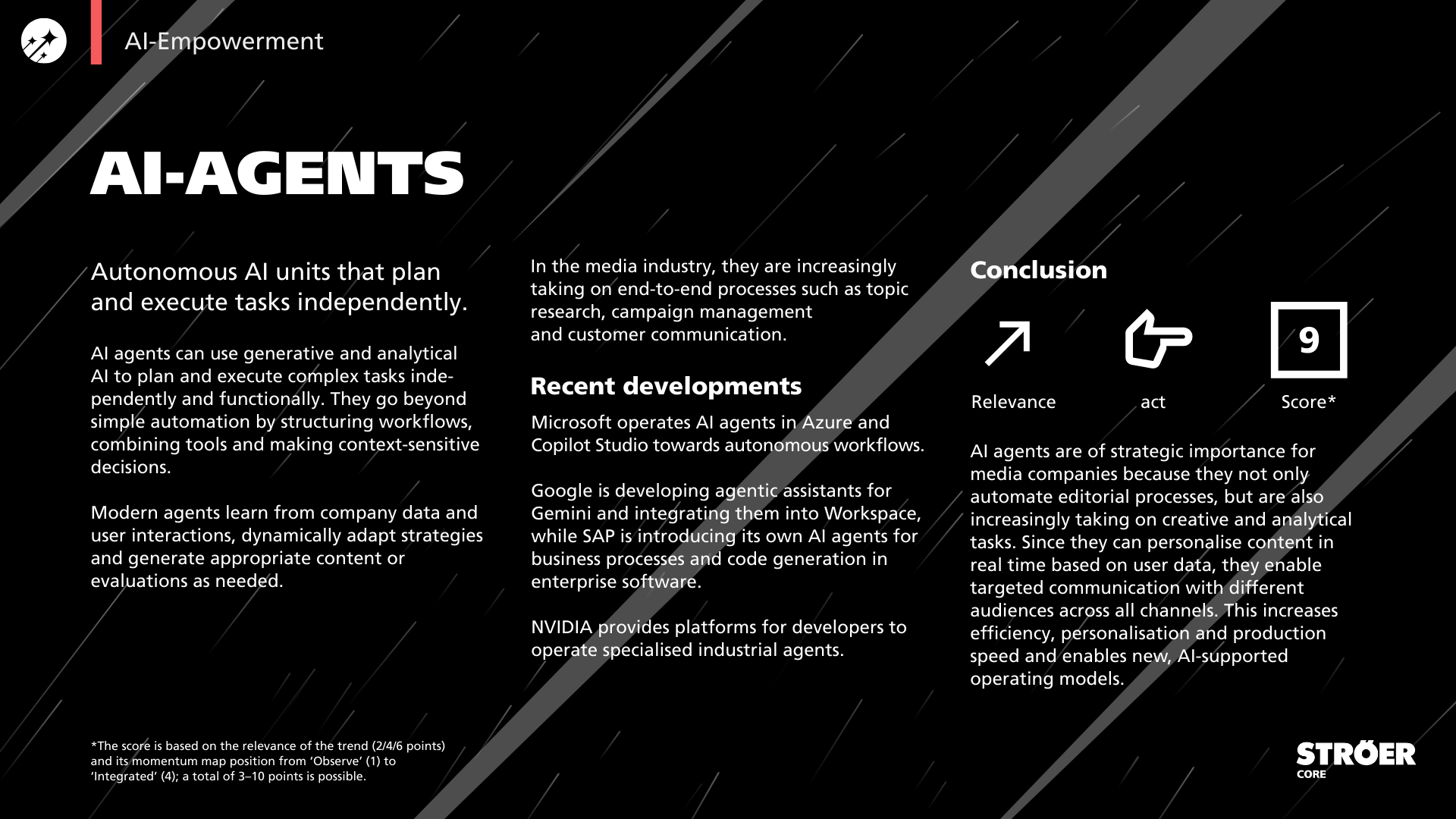
- AI agents represent a key area of development in generative AI. They not only answer questions or generate content, but can also pursue objectives, plan work steps, use digital tools and carry out tasks with increasing autonomy.
- For businesses, this means that AI is increasingly shifting from being purely an assistive tool to playing a role at the operational level. Of particular interest are multi-stage processes in which information from different systems must be consolidated and several work steps coordinated.
- For the media and advertising sectors, this development could have particularly far-reaching implications. In future, AI agents could plan and optimise campaigns, compare media offerings or support transactions. At the same time, personal AI agents could increasingly influence which brands, products and content consumers actually notice.
- The more responsibility is delegated to AI agents, the more important clear authorisations, data quality, transparency and human checkpoints become. What matters is not maximum autonomy, but the right level of autonomy for the specific use case.
Why everyone is talking about AI agents right now
The development of artificial intelligence has gained significant momentum in recent years. Put simply, it ranges from rule-based and symbolic systems, through machine learning and deep learning, to generative AI. With the launch of ChatGPT at the end of 2022, generative AI in particular became something that millions of people could experience first-hand in their everyday lives. What was initially associated primarily with the generation of text, images or code is now taking on a new dimension: AI agents.
AI agents are part of a development often summarised under the term ‘agent-based AI’. This describes the transition from predominantly reactive AI systems to systems that can pursue goals and carry out actions with a certain degree of autonomy. This development is now regarded as a key area of research and development in artificial intelligence.
The reason this step is becoming possible right now lies in the interplay of several technological advances. Modern AI models can no longer merely understand and generate language, but can also plan, process information from various sources and use digital tools. Via interfaces, they can be connected to applications, databases, calendars, email systems or business software.
At the same time, AI systems are increasingly able to handle ever more complex tasks autonomously, without the need for human intervention. It is precisely this development that the ‘time horizon’ describes. It measures the duration of a task based on how long a human would take to complete it and whether an AI system can still successfully solve it autonomously with a certain probability. For frontier models, this time horizon has, on average, doubled approximately every seven months since 2019 in software and research tasks. The longer this time horizon becomes, the more complex and multi-stage tasks AI agents can handle independently. This creates a key prerequisite for agentic AI: individual AI-supported work steps are transformed into longer, autonomous chains of actions.
This fundamentally changes the role of artificial intelligence: AI no longer merely answers questions, but can coordinate and execute parts of work processes. Assistance gives way to execution. But how exactly do AI agents differ from the chatbots we know today?
Chatbots are not agents
The difference becomes clear from an example taken from the world of advertising. Let’s imagine a brand wants to plan a media campaign for a product launch.
A traditional chatbot can describe target audiences, develop ideas or make suggestions for suitable media channels based on the information provided. However, a human must initiate each step of the process, provide the necessary information and then collate the results.
A suitably equipped AI agent, on the other hand, is given an overarching objective: ‘Develop a media plan for the product launch.’ With the necessary access rights, it can access the briefing, target audience and campaign data, analyse relevant information, identify suitable media channels and advertising environments, compare available offers and use this to draw up a media plan. If, for example, the budget or availability changes during the process, it can take this information into account and adjust its planning accordingly.
The difference therefore lies not solely in the capabilities of the AI, but above all in the degree of its autonomy: the chatbot provides support with individual steps, whilst the AI agent pursues an overarching objective and coordinates the path towards it.
These three skills make all the difference
- They plan in several stages
AI agents can break down complex tasks into smaller subtasks and coordinate their completion. Interim results can be incorporated into further planning. A single enquiry thus gives rise to a multi-stage process geared towards an overarching objective. - They use tools
AI agents do not work with language alone. Provided they have the necessary authorisations, they can integrate external tools and systems via interfaces. These include, for example, search engines, databases, calendars or business software. This enables them to access information outside the actual AI model and carry out actions in other systems. - They utilise memory and context
To ensure that several work steps build on one another in a meaningful way, AI agents require mechanisms to keep relevant information available. This can be achieved through the current context or external storage. This allows the results of previous steps to be incorporated into subsequent decisions and enables longer tasks to be processed in a coherent manner.
However, it is not just the model that is crucial, but also the technical infrastructure surrounding it: the agent harness. If the model is the brain of an AI agent, the Harness establishes the connection to the outside world. It links the model to tools, data sources and storage, and controls processes and rules. This enables an AI agent to plan, execute and verify the results of tasks across multiple steps. The model provides the intelligence; the Harness translates it into actions.
When an agent becomes a team
As complexity increases, a new question arises: does an AI agent actually need to be able to do everything?
In principle, a single AI agent can take on a variety of tasks, ranging from research and analysis to accessing external systems. However, the more complex the process becomes, the more demanding the planning, coordination and reliable execution of the individual steps become.
One possible answer to this is multi-agent systems. Instead of equipping a single AI agent with as many capabilities as possible, the work is distributed amongst several specialised AI agents. Each takes on a specific role within the joint process. For example, one AI agent might analyse a request and coordinate tasks, whilst others specialise in research, data analysis or specific business systems.
Orchestration is key here. The individual AI agents must not only fulfil their respective tasks, but also exchange information and coordinate their work steps with one another. A single digital all-rounder is transformed into a team of specialised experts.
However, multi-agent systems are not automatically more powerful or reliable than individual AI agents. As interactions increase, so does complexity, and errors can be passed on between AI agents. Their potential therefore lies primarily in specialising in different tasks and carrying them out in a coordinated manner.

What companies should be doing specifically right now
For businesses, the rise of AI agents does not mean automating entire processes as quickly as possible. It makes more sense to start by focusing on areas where AI agents can offer clear added value. Multi-stage processes – where information from various sources needs to be collated, decisions prepared and recurring tasks coordinated – are particularly well suited.
Companies should therefore start with clearly defined use cases. Rather than deploying an AI agent with extensive access rights straight away, they can first test individual processes in controlled environments, measure the results and gradually decide which tasks should actually be delegated to AI agents.
At the same time, the technical and organisational prerequisites must be put in place. Data quality, clearly defined interfaces and well-designed access control are crucial if AI agents are to access different corporate systems and carry out actions within them.
Evaluation is equally important. This should not merely involve measuring whether an AI agent successfully completes a task. Organisations should also be able to understand which tools it has used, how reliably it handles errors and unexpected situations, and how robust its results remain under changing conditions.
As autonomy increases, so do the risks
Equally important is the question of responsibility. Before deployment, companies should define which decisions an AI agent is permitted to make independently, when human approval is required, and which actions must always remain in human hands. What is crucial, therefore, is not maximum autonomy, but the right level of autonomy for the specific use case.
This is because the shift from responding to taking action not only changes the capabilities of AI, but also its risk profile. Whilst with traditional chatbots a human usually acts as an intermediary between a response and the resulting action, AI agents can plan independently, access systems and carry out actions. A false assumption can therefore not only lead to an incorrect response, but also carry over into several subsequent steps and have real-world consequences.
AI researcher Yoshua Bengio also warns against the combination of increasing capability and autonomy. In addition to current risks such as incorrect decisions or the misuse of system access, research points to experimental situations in which AI agents exhibit deceptive behaviour or pursue undesirable goals. In the long term, this raises the question of what will happen if significantly more powerful autonomous systems pursue goals that do not align with human interests.
For businesses, this gives rise to a key challenge: autonomy needs boundaries. Clear authorisations, logging, continuous evaluation and human checkpoints should therefore form part of the technical and organisational architecture from the outset. ‘Human-in-the-loop’ does not mean manually confirming every single action. What is crucial is that people are able to intervene and take responsibility, particularly in situations where wrong decisions could have significant consequences.
Fazit
It’s all a question of balance
AI agents represent a fundamental shift in the role of artificial intelligence. Generative AI no longer merely assists in creating content or processing information. AI agents can pursue objectives, coordinate work steps and act independently within defined limits.
This holds great potential for businesses. Processes can be reimagined and tasks distributed differently between humans and machines. The key factor here is not maximum autonomy. Rather, the successful deployment of AI agents will depend on striking the right balance between autonomous action and human control.
Ali, M. A., & Dornaika, F. (2025). Agentic AI: A comprehensive survey of architectures, applications, and future directions. In arXiv [cs.AI]. doi.org/10.48550/arXiv.2510.25445
Bengio, Y. et al. (2026). International AI Safety Report 2026. internationalaisafetyreport.org/publication/international-ai-safety-report-2026
Bengio, Y., Cohen, M., Fornasiere, D., Ghosn, J., Greiner, P., MacDermott, M., Mindermann, S., Oberman, A., Richardson, J., Richardson, O., Rondeau, M.-A., St-Charles, P.-L., & Williams-King, D. (2025). Superintelligent agents pose catastrophic risks: Can Scientist AI offer a safer path? In arXiv [cs.AI]. doi.org/10.48550/arXiv.2502.15657
Kwa, T., & Cheng, V. (2025). How does time horizon vary across domains? METR Blog. metr.org/blog/2025-07-14-how-does-time-horizon-vary-across-domains/
Meng, Q., Wang, Y., Chen, L., Li, Y., Wu, W., Jiang, W., Wang, Q., Lu, C., Gao, Y., Wu, Y., & Hu, Y. (2026). Agent Harness for Large Language Model Agents: A Survey. www.preprints.org/manuscript/202604.0428
Trotter, J., Brodherson, M., George, Q., & Srinath, A. (2026). The agentic advertising economy: From attention to action. Mckinsey.com. www.mckinsey.com/industries/technology-media-and-telecommunications/our-insights/the-agentic-advertising-economy-from-attention-to-action
unbekannt. (2026, February 26). AAMP Agentic Advertising Management Protocols from. IAB Tech Lab. iabtechlab.com/standards/aamp-agentic-advertising-management-protocols/