


05. March 2026
Trusted Ecosystems: When trust becomes currency
- New
The question of authenticity characterises media consumption. Where does the content come from? Is the sender a real person, or is it a bot? To what extent have texts, images, and videos been altered by generative AI? Does the referenced source really exist, or is it a hallucination of a language model?
While generative content was easy to identify at first or second glance in the past, whether due to conspicuous writing patterns or unusually shaped hands with seven fingers, with the advancement of LLMs, it is becoming increasingly difficult to identify, and will soon be almost impossible.
On the other hand, there is AI slop. This inferior synthetic media is easily recognisable as AI-generated, and it floods the internet with misinformation in order to generate clicks and advertising revenue while eroding trust in digital content. This makes it harder to find high-quality content from authentic sources.
In addition to the information that users consume, the way information flows is also critically examined. What information have the chatbots stored, and where does personal data go? What content do the models access, and are the authors fairly compensated for it?
Trustworthy digital ecosystems are transparent about their data usage and content origin, and respect user sovereignty.
Historically, these expectations were mostly associated with decentralised approaches, which have not yet achieved widespread adoption due to network effects, poor user experience, and a lack of standards.
By 2025, publishers had lost valuable traffic due to 'zero-click searches', and the AI-supported scaling of content creation had resulted in reputational damage. The phased implementation of the EU AI Act and the development of new standards indicate that implementation will begin in 2026.
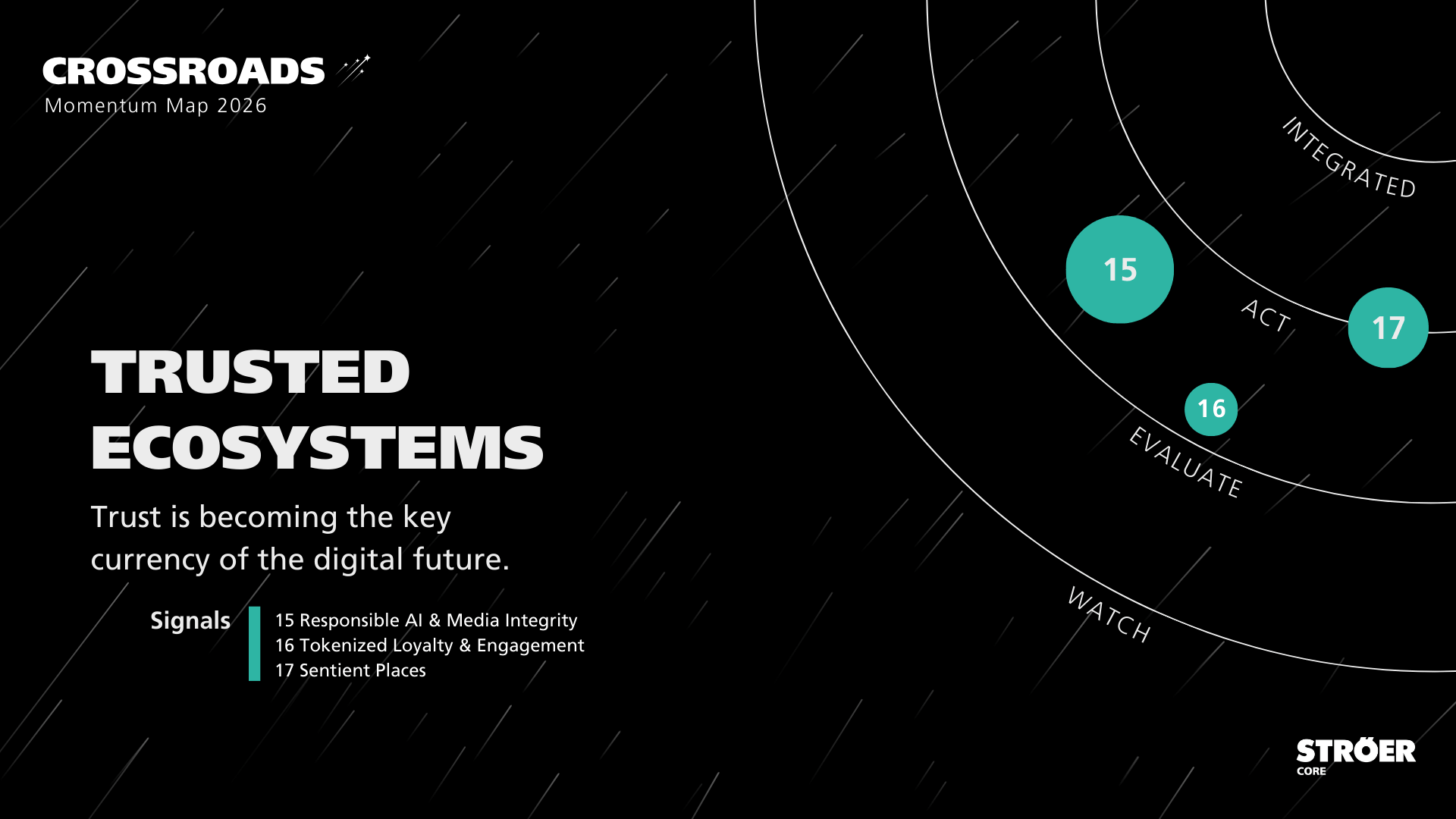
In this context, three signals were identified for the Trusted Ecosystems cluster:
- Responsible AI and media integrity: Creating governance and standards to strengthen authentic content creators and high-quality content.
- Tokenized Loyalty & Engagement: Tapping into new monetisation models using tokens that allow users to reward high-quality content.
- Sentient Places: Spaces that respond to changes in real time to improve quality of life, supported by high-quality data, responsibility and traceability.
These three areas mark technological development paths and provide guidelines for quality assurance, platform transparency, community engagement and data-driven media experiences in public spaces.
The answer to AI slop, lack of transparency and declining trust
Responsible AI & Media Integrity
New technologies, regulations and standards are being developed to preserve the authenticity of digital content and platforms, as well as to promote the responsible use of artificial intelligence in communication.
AI slop is one of the latest challenges facing brands, publishers and platforms. While the long-term consequences are unclear, there are already some negative short-term effects: users are reporting increasing apathy, and some are turning away from digital information sources. Superficial, populist treatments of topics are suspected of dumbing down discourse, and users may find it increasingly difficult to distinguish high-quality content from poor-quality content.
Platforms whose recommendation algorithms prioritise reach and engagement amplify AI slop because it is more provocative and emotional than editorially vetted, high-quality content. The moderation mechanisms of Instagram and Facebook currently need further development as most AI slop does not fit into the current guidelines unless it is obviously harmful content.
Users should find it easier to distinguish between synthetic and human-created content. One way to achieve this would be to label them with 'content credentials'. The C2PA standard provides information about the origin and editing history of media data, making manipulation easier to detect. Cryptographic signatures protect this data from manipulation and enable users to view it via software or an online service. The German company Leica, for example, has integrated content credentials into its M11-P camera model, and some news agencies and media companies are using this standard to strengthen the credibility of their reporting.
In addition, algorithms can prioritise factors other than engagement, such as source credibility or information quality, to reduce the reach of inferior, synthetic content. Reddit's community structure demonstrates how moderators remove harmful or inappropriate posts from forums. This positions the platform as a place for authentic human interaction, setting it apart from other social networks. In practice, however, moderation of various subreddits can be inconsistent and problematic if they are moderated too heavily or lightly. However, it should be remembered that Reddit has data from over 20 years of human user conversations, which is an extremely valuable resource for advertisers or developers of AI models.
In addition to new standards and technologies, the EU AI Act is also associated with this development. Effective regulation of AI can foster trust, facilitating adoption and providing access to larger markets. The approach itself is technology-neutral, regulating AI on the basis of risk – different obligations apply to providers and operators depending on the use case.
The ‘Responsible AI & Media Integrity’ signal is gaining momentum. The facets discussed here represent only a small part of the topic. At its core, the focus is on technologies and standards that can bolster trust in digital media and lay the groundwork for a new media economy, where the origin and subsequent handling of content can be documented in an unalterable manner and, in the future, support billing and copyright processes.
When commitment is not only measured, but rewarded
Tokenized Loyalty & Engagement
Signal Tokenized Loyalty & Engagement demonstrates how brands are seeking to develop a new kind of relationship with their users. Users provide attention, data and interactions, thereby generating measurable value in the form of reach, advertising revenue and much more. However, media can only convert this into stable revenue and lasting relationships to a limited extent. This is because the relationship between users and brands is mediated via the platform (search, social feeds), monetisation is mostly binary (paywall, subscription or advertisements), and tracking and targeting are made more difficult by regulations. Furthermore, engagement as a KPI can be easily devalued by bots and clickbait.
A new approach aims to address these issues by translating engagement into a redeemable unit. This can take the form of tokens. Brands can link their fans' status, co-determination on brand-relevant topics or even access to exclusive content or events to their users' engagement. This allows fleeting attention to be transformed into a stronger, more trusting connection with the brand, without users having to reveal more personal data. It should be noted that this approach can be seen as a supplement to existing paywall or platform logic, rather than a replacement.
In practice, NFTs can be used as access keys, which users store in their personal wallets. When entering a brand's ecosystem — for example, a website — the NFT would verify the user's membership and make exclusive content visible. This is beneficial for data protection because brands can dispense with traditional accounts and passwords – ownership of the NFT is proven via the blockchain.
In traditional loyalty programmes, however, user data is stored in a company database. Rewards in these programmes are usually static, whereas newer concepts use smart contracts to make rewards flexible, personalised and context-specific. These rewards then have a resale value, which gives memberships special value. Cross-brand collaborations should also be possible so users are not limited to a single brand ecosystem.
Overall, this approach offers brands several advantages: greater security, since memberships cannot be forged thanks to blockchain technology; and greater cost-effectiveness, since traditional third-party providers are eliminated and brands can interact directly with the community. However, new risks arise for users, such as phishing attacks, whereby they connect their wallet to fake reward sites and confirm transactions that grant permanent access rights. Another issue with this concept is its ecological footprint, as blockchain technology is very energy-intensive.
The Brave Rewards programme demonstrates how users can receive Basic Attention Tokens in exchange for their attention, and how publishers or merchants can join the platform: users collect tokens by viewing privacy-friendly advertisements in the Brave browser. They can then use these tokens to support creators on various platforms. This mechanism enables advertisers to continue viewing the performance of their ads while protecting user privacy. Unlike Google Ads, it is not possible to track actions back to individual users; however, advertisers can see how often their ad is shown and clicked on, and depending on the setup, they can access aggregated information on downstream actions.The Brave ecosystem currently includes publishers such as The Guardian, Vimeo, and The Washington Post.
It is still unclear whether these new approaches to loyalty programmes, which include NFTs and decentralised technologies, will catch on. These technologies continue to face the familiar adoption hurdles. To be successful with the masses, concepts must be low-threshold and user-friendly. Privacy is a major advantage for users, and brands can use these mechanisms to cultivate a more trusting relationship with their community.
Overall, this approach presents many opportunities for media companies, agencies and advertisers, for example through community tokens, NFT-based access to events or user-controlled content curation. This creates flexible, gamified access to content and communities. At the same time, it enables marketers to establish a direct link between target group loyalty and monetisation.
How data-driven spaces react to their surroundings
Sentient Places
The concept of smart cities has long been a vision for the future of German urban areas. They are intended to be fully digitally networked, collecting data on weather, traffic and much more to make life more efficient. However, many smart city initiatives only offer visualisation and monitoring. They recognise events, but are often not sufficiently integrated to reliably deduce causes or orchestrate measures systematically.
Germany's current infrastructure is not prepared for the challenges ahead, such as rapid demographic change and an increasingly volatile climate. A new concept is filling this gap: Sentient Places.
These cities and places continuously collect data on air quality, traffic, and energy consumption to inform data-driven decision-making and trigger partially automated measures. This enables traffic flows to be dynamically controlled to prevent congestion. It can also reduce energy consumption and environmental pollution.
This is made possible by AI models that can understand the physical environment. Spatial AI uses a combination of computer vision, sensor technology and audio signals to develop an understanding of space that goes beyond mere object recognition, incorporating situations, movements and context.
In Hamburg, Breeze Technologies is testing a hyperlocal air quality platform that uses IoT sensor technology and a citizen portal. In Munich, a consortium led by the Technical University of Munich is creating a digital twin of the city to visualise environmental, traffic and energy data in real time.
The village of Etteln near Paderborn is demonstrating 'sentient places' on a small scale: it uses energy-saving LoRaWAN (Long Range Wide Area Network) radio technology to connect a large number of sensors and collect and transmit data. These sensors measure temperature, humidity, groundwater and river levels, rainfall, and the fill level of used clothing containers, among other things. Using this sensor data alongside drone images of the entire village, a digital twin of Etteln has been created. As measurement data is collected over a long period of time — for example, on river levels, soil moisture, water levels and rainfall — it is possible to create flood protection simulations, assess scenarios more effectively and issue early warnings. Data protection is also taken into account: no personal data is collected.
This creates new opportunities for media companies at Sentient Places, such as becoming data partners, infotainment providers, or urban storytelling studios. Editorial teams can work with city dashboards to deliver personalised, real-time news to public screens, or develop location-based narratives in conjunction with DOOH spaces or virtual AR formats, for example.
Trust is essential for the success of Sentient Places. If infrastructure can predict and respond semi-autonomously to developments, the training data and models must be checked for bias and the decision-making criteria must be transparent. For instance, a system that regulates urban mobility should not only optimise travel times, but also ensure equal access to structurally weaker neighbourhoods. As AI systems collect and process large amounts of data, privacy-by-design approaches are crucial. Ideally, cities and municipalities should involve citizens in the project from the outset, rather than only after implementation.
Modernising infrastructure to create 'sensory cities/places' can take decades and require significant investment. However, if governance and data protection are in place, the benefits in terms of quality of life, economic competitiveness and climate resilience can be considerable.


Conclusion
Media as trust builders
Trust is therefore not just a soft factor, but an infrastructural prerequisite for digital media and communication spaces. In an environment where content is becoming increasingly synthetic and difficult to verify, its relevance is determined less by its reach than by its traceable origin, transparent processing and clear responsibilities. Meanwhile, there is growing pressure on publishers and brands to develop viable revenue models that do not involve further tracking of users or forcing them into binary access models.
The three signals in the 'Trusted Ecosystems' cluster outline complementary development paths for this. Responsible AI & Media Integrity establishes the basis for ensuring authenticity and quality standards from technical, organisational, and regulatory perspectives. Tokenized Loyalty & Engagement shifts the exchange of value towards programmable, data-efficient relationships, linking participation, access and monetisation more closely. Sentient Places extends this concept to public spaces, where data-based systems will only be accepted if their decision-making logic is fair, auditable, and implemented with privacy by design.
2026 will therefore not mark the beginning of a completely new order, but rather the phase in which standards, governance and user-centred implementation determine adoption. Trusted ecosystems will arise where transparency, protective mechanisms and incentive systems work together, and where trust is embedded as a quantifiable, malleable resource within products, platforms and communication.
Make sure you don't miss out by following us: check our blog regularly or follow us on LinkedIn!
Some of the media content in this blog post was created using artificial intelligence (AI).
Accelerating Europe’s AI adoption: The role of sovereign AI. (2025, December 19). Mckinsey.com. www.mckinsey.com/industries/technology-media-and-telecommunications/our-insights/accelerating-europes-ai-adoption-the-role-of-sovereign-ai
AI Slop: Künstliche Intelligenz, digitale Videos und KI-Müll im Internet und auf TikTok & Co. - Psychotherapie Berlin. (n.d.). Praxis-psychologie-berlin.de. Retrieved March 3, 2026, from www.praxis-psychologie-berlin.de/wikiblog/articles/ai-slop-k%C3%BCnstliche-intelligenz-digitale-videos-und-ki-m%C3%BCll-im-internet-und-auf-tiktok-co
Anthropic setzt mit werbefreier KI-App auf Vertrauen. (2026, February 7). Anthropic setzt mit werbefreier KI-App auf Vertrauen. www.ad-hoc-news.de/boerse/news/ueberblick/anthropic-setzt-mit-werbefreier-ki-app-auf-vertrauen/68562078
Avax.network — the future of fan engagement. (n.d.). Avax.netWork — The Future of Fan Engagement. Retrieved March 3, 2026, from www.avax.network/case-studies/the-future-of-fan-engagement
Basic Attention Token. (1 C.E., January 1). Basic Attention Token. basicattentiontoken.org/de/
Brahmstaedt, K. (2025). Community and consumer dynamics in NFTs: Understanding digital asset value through social engagement. Journal of Consumer Behaviour, 24(4), 1630–1655. doi.org/10.1002/cb.2482
Bundeszentrale für politische Bildung. (2021, June 23). Krieg in den Medien. bpb.de; Bundeszentrale für politische Bildung. www.bpb.de/themen/medien-journalismus/krieg-in-den-medien/500389/authentizitaet/
Chukwube, M. (2025, September 8). Warum ein dezentrales Internet bis 2030 unvermeidlich ist (oder nicht). Hackernoon.com. hackernoon.com/lang/de/warum-ein-dezentrales-internet-bis-2030-unvermeidlich-ist-(oder-nicht)
Kostar, N. (n.d.). Vitalik Buterin benennt dezentrale soziale Medien als wichtiges Thema für 2026. Msn.com. Retrieved March 3, 2026, from www.msn.com/de-de/finanzen/top-stories/vitalik-buterin-benennt-dezentrale-soziale-medien-als-wichtiges-thema-f%C3%BCr-2026/ar-AA1UL8Ca
Medien und Marken müssen ins Fediverse! (2025, September 1). MEEDIA. meedia.de/news/beitrag/19999-medien-und-marken-muessen-ins-fediverse.html
Queitsch, M. (2023, September 8). Vertrauen in digitale Systeme. Bertelsmann THE; Trusted Health Ecosystems. trusted-health-ecosystems.org/vertrauen-in-digitale-systeme/
Reddit setzt auf Menschen gegen die KI-Flut. (2026, February 7). Reddit setzt auf Menschen gegen die KI-Flut. www.ad-hoc-news.de/boerse/news/ueberblick/reddit-setzt-auf-menschen-gegen-die-ki-flut/68560970
Rossant, J. (2025, December 4). Smart cities failed. Sentient cities are coming next. Context.News; Context. www.context.news/climate-risks/opinion/smart-cities-failed-sentient-cities-are-coming-next
Roth, M. (2025, May 29). Was sich gegen die Macht großer Online-Plattformen tun lässt. MDR. www.mdr.de/nachrichten/deutschland/online-plattformen-macht-alternative-100.html
Scheuer, S. (2025, December 29). Künstliche Intelligenz: Wie KI uns in eine digitale Vertrauenskrise stürzt. Handelsblatt. www.handelsblatt.com/meinung/kommentare/kuenstliche-intelligenz-wie-ki-uns-in-eine-digitale-vertrauenskrise-stuerzt/100179829.html
Siu, E. (2025, June 17). Web3 loyalty tokens drive 28% higher customer engagement. Single Grain. www.singlegrain.com/customer-retention/web3-loyalty-tokens-drive-28-higher-customer-engagement/
StartupValley. (2025, November 25). Können wir digitalen Bildern überhaupt noch trauen? StartupValley - Erfolgreich Gründen und durchstarten!; StartupValley Media. startupvalley.news/de/gretchen-ai-zu-kontext-und-vertrauen-in-digitalen-medien/
tlc-germany. (2025, April 2). Warum die meisten Loyalty-Programme scheitern – und wie Ihres erfolgreich bleibt. TLC Worldwide. www.tlcworldwide.com/germany/loyalty-programme-scheitern/
Token gating for retailers in 2026: How to use NFTs for exclusive access. (n.d.). Shopify. Retrieved March 3, 2026, from www.shopify.com/blog/token-gating
Übersicht über das KI-Gesetz. (n.d.). Artificialintelligenceact.eu. Retrieved March 3, 2026, from artificialintelligenceact.eu/de/high-level-summary/
Vertrauen ist menschlich. (n.d.). Leibniz-gemeinschaft.de. Retrieved March 3, 2026, from www.leibniz-gemeinschaft.de/en/about-us/whats-new/news/forschungsnachrichten-single/newsdetails/vertrauen-in-nachrichten-stabil-ki-generierte-nachrichten-stossen-auf-skepsis
Viele Journalisten nutzen KI-Tools im Job. Gefährdet das die Glaubwürdigkeit von Medien? (n.d.). Deutschlandfunk; deutschlandfunk.de. Retrieved March 3, 2026, from www.deutschlandfunk.de/ki-medien-journalismus-vertrauen-glaubwuerdigkeit-100.html
Wald, M. (2026, February 9). 650 Milliarden Dollar KI-Wette – und Europa schaut zu. Business Punk. www.business-punk.com/tech/650-milliarden-dollar-ki-wette-und-europa-schaut-zu/2/
Wegner, J. (2026, February 11). Interviewpodcast “Nur eine Frage” – KI-Übersetzung: Verlieren junge Menschen das Vertrauen in Medien, Richard Edelman? DIE ZEIT. www.zeit.de/wissen/2026-02/richard-edelmann-vertrauen-in-medien-nur-eine-frage-interview-podcast
Wie dezentrale Social-Media-Plattformen die Abhängigkeit unserer digitalen Öffentlichkeit von Big Tech verringern können. (2025, November 13). Bertelsmann-stiftung.de. www.bertelsmann-stiftung.de/de/unsere-projekte/reframetech-algorithmen-fuers-gemeinwohl/projektnachrichten/dezentrale-social-media-plattformen-als-chance-fuer-ein-resilientes-informationsoekosystem
Wie ein Dorf zum Vorreiter der Digitalisierung wurde. (n.d.). Deutschlandfunk Kultur; deutschlandfunkkultur.de. Retrieved March 3, 2026, from www.deutschlandfunkkultur.de/digitalisierung-etteln-smart-city-glasfaser-100.html
(N.d.). Bundesdruckerei.de. Retrieved March 3, 2026, from www.bundesdruckerei.de/de/innovation-hub/content-credentials