


05. February 2026
Smart Commerce & Media: When content becomes a market
In 2026, the customer journey will be neither predictable nor linear. Inspiration, information, and purchase will no longer take place sequentially, but simultaneously, in feeds, videos, dialogues, and increasingly in AI-driven environments. Users no longer expect just content, but guidance, relevance, and decision support at the right moment.
For media companies, this development marks a structural turning point. Those who deliver reach alone remain interchangeable. Value is created where media intelligently combine context, action, and conversion.
At the heart of this is a fundamental change: media and commerce are growing together into an integrated system. Media are taking on a new role in this process. They are no longer mere providers of reach, but orchestrators of attention, context, and conversion. Relevance arises where content not only tells a story, but also enables decisions.
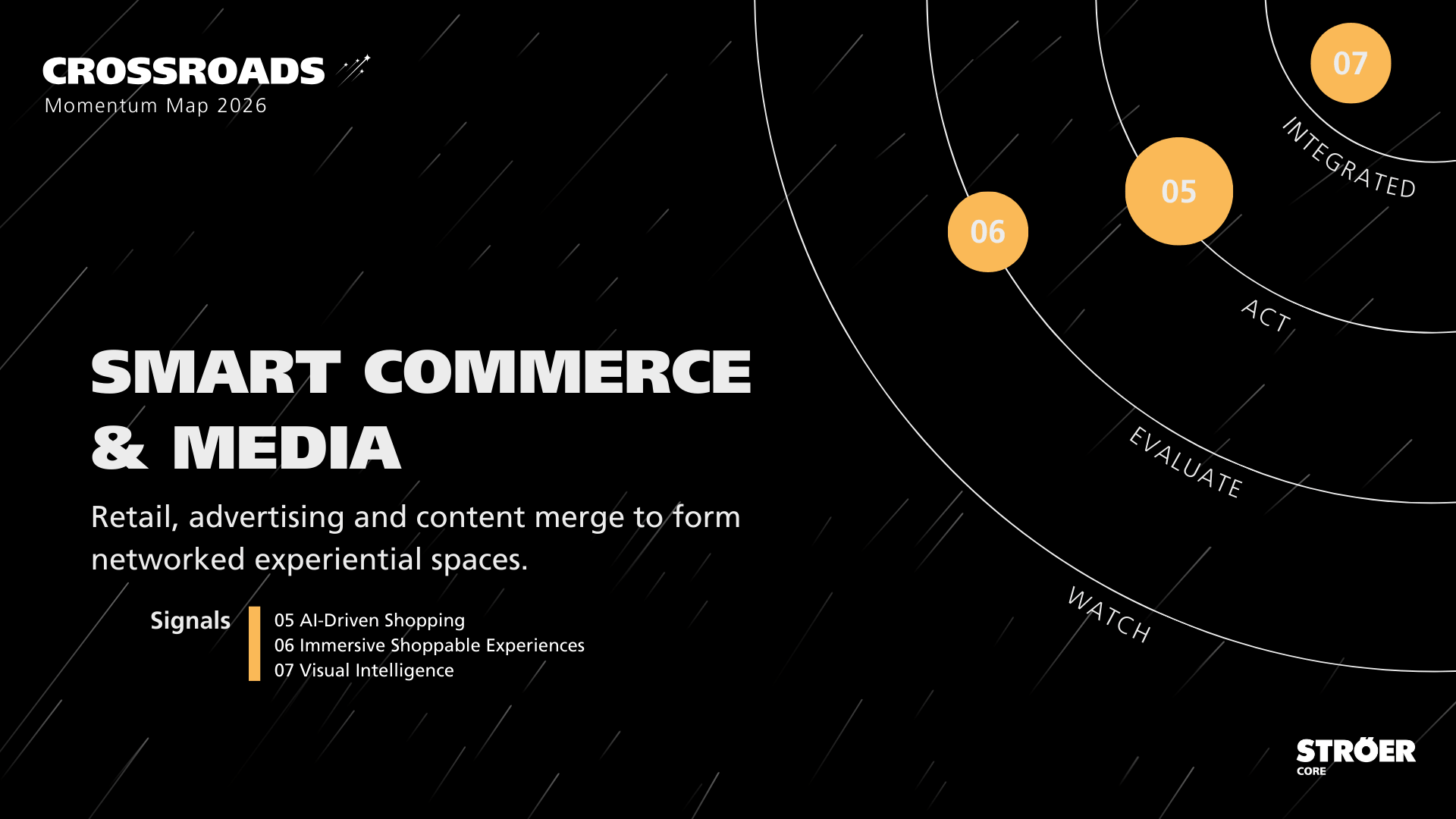
This macro trend can be seen particularly clearly in three defining signals that are fundamentally changing the media and platform business: AI-driven shopping, immersive shoppable experiences, and visual intelligence.
Commerce on autopilot
AI-Driven Shopping
Product searches are increasingly shifting from traditional search masks to dialogue-based AI interfaces. Users no longer enter keywords, but rather their needs. AI systems advise, compare, prioritize, and guide users, sometimes autonomously, to a transaction.
AI-supported assistants such as ChatGPT, but also shopping functions on large platforms such as Amazon or Google, are already demonstrating how this change is taking place. They combine product reviews, price developments, availability, and individual preferences to produce specific recommendations for action. The purchasing process no longer begins with a search, but with a decision template prepared by AI.
For media environments, this represents a paradigm shift. Articles, videos, and reviews no longer serve merely as sources of information, but as contextual triggers from which AI derives purchase intentions. Editorial content is read, interpreted, and translated into decision-making logic, for example when product recommendations, comparisons, or usage scenarios are incorporated into AI-based response systems.
At the same time, publishers and platforms are integrating structured product and content data in such a way that it can be interpreted by AI systems. The decisive factor is no longer maximum reach, but relevance within algorithmic decision-making processes. Visibility arises where content is semantically clear, comparable, and contextually relevant, and not necessarily where it is played out most loudly.
Media providers are no longer just competing for attention, but for relevance in AI decision-making logic. Those who intelligently link content, products, and metadata become part of the purchasing process, even without a traditional shop.
Real-time worlds for customers
Immersive Shoppable Experiences
Shoppable content is not a new phenomenon. What is new is its consistent, systemic integration. Short videos, livestreams, social formats, and interactive screens now connect content, community, and commerce without media discontinuity. Inspiration, interaction, and purchase coincide in a single moment.
Platforms such as TikTok and Instagram show how this logic is establishing itself: creators present products directly in the content, answer questions in real time, and seamlessly integrate purchasing options into the user experience. Formats such as live shopping and shoppable videos make purchasing a natural part of storytelling, rather than an interruption.
Here, too, AI is becoming increasingly important. Product selection, sequence, and presentation are dynamically adapted to user behavior, context, and situation. The experience is no longer planned statically, but orchestrated situationally. Commerce platforms such as Amazon are also experimenting with livestreams and interactive formats that merge entertainment, advice, and transactions.
Immersive shoppable experiences are not limited to purely digital channels. Interactive screens, events, or digital outdoor advertising respond to the environment, time of day, or audience structure and enable spontaneous interaction, right through to mobile purchases. The experience does not end on the screen, but continues across channels: from physical space to digital touchpoints and back again.
Immersive shoppable experiences make media actionable. Competition is no longer decided by individual formats, but by the quality of the integration of content, interaction, and transaction. Media become spaces for experiences in which attention immediately translates into action.
Adaptive worlds on every screen
Visual Intelligence
Visual intelligence gives media environments a new capability: situational understanding. AI no longer just recognizes what can be seen in images or videos, but also interprets context, impact, and relevance for different target groups. As a result, visual content is not displayed statically, but is dynamically understood and adapted.
In practice, this can be seen in AI-powered advertising and media systems that vary visual content in real time. Platforms such as Google and Meta use visual AI to automatically analyze, optimize, and play out creatives in a context-sensitive manner, adapted to the usage situation, end device, or target group. Generative image and video models enable a new level of scaling: personalized visuals are created on demand, without manual production for each variant.
This change is particularly evident in the field of digital outdoor advertising. AI-supported DOOH systems are evolving to capture environmental factors such as weather, time of day, or traffic flows in real time and incorporate them into the display. Motifs are thus increasingly adapted to the situation.
Editorial media are also increasingly benefiting from visual intelligence. Content is automatically tailored, extended, or recombined depending on which screen it is displayed on, at what moment, and for which audience. Visual formats thus adapt dynamically to usage contexts without losing their editorial core.
Visual intelligence makes visual media capable of making decisions. Those who can interpret visual signals in a context-sensitive manner and translate them into dynamic playback transform channels into intelligent touchpoints with measurable impact.


From consumption to consistency
Media become decision-making spaces
Smart commerce & media is not an add-on, but a fundamental system change. Content, interfaces, and AI are converging to form integrated decision-making architectures. Media no longer just inform and inspire; they structure options, provide guidance, and influence decisions throughout the entire customer journey. Those who master this logic will not become a salesroom, but a relevant decision-making partner in everyday digital life.
Make sure you don't miss out by following us: check our blog regularly or follow us on LinkedIn!
Some of the media content in this blog post was created using artificial intelligence (AI).
Evans, M., Derow, R., Krogman, M., & Gregor, L. (2025, October 6). Agentic commerce is redefining retail—here’s how to respond. BCG Global. https://www.bcg.com/publications/2025/agentic-commerce-redefining-retail-how-to-respond
Laleva, N. (n.d.). IAB Europe’s Retail & Commerce Media Definitions One Pager. IAB Europe. Retrieved January 28, 2026, from https://iabeurope.eu/knowledge_hub/iab-europes-retail-commerce-media-definitions-one-pager/
Retail media and AI drive the future of digital commerce. (n.d.). Warc.com. Retrieved January 28, 2026, from https://www.warc.com/content/feed/retail-media-and-ai-drive-the-future-of-digital-commerce/en-GB/9548
Rincon, L. (2025, May 20). Shop with AI Mode, use AI to buy and try clothes on yourself virtually. Google. https://blog.google/products-and-platforms/products/shopping/google-shopping-ai-mode-virtual-try-on-update/
The future of commerce media 2025. (n.d.). Warc.com. Retrieved January 28, 2026, from https://www.warc.com/content/article/warc-data/the-future-of-commerce-media-2025/en-gb/162035
The future of shoppable media can build on the success of social shopping. (2023, September 10). Deloitte Insights; Deloitte. https://www.deloitte.com/us/en/insights/industry/technology/future-of-shoppable-media.html
Trotter, J., Brodherson, M., & George, Q. (2025, May 29). The evolution of commerce media: Navigating a new era in advertising. Mckinsey.com; McKinsey & Company. https://www.mckinsey.com/capabilities/growth-marketing-and-sales/our-insights/the-evolution-of-commerce-media-navigating-a-new-era-in-advertising
Zettler, P. (2025, October 16). Agentic Commerce: KI-Agents revolutionieren den Online-Handel. OMR Reviews. https://omr.com/de/reviews/contenthub/agentic-commerce
(N.d.-a). Reuters.com. Retrieved January 28, 2026, from https://www.reuters.com/business/media-telecom/ai-powered-ads-drive-growth-global-entertainment-media-industry-pwc-says-2025-07-24/
(N.d.-b). Skai.Io. Retrieved January 28, 2026, from https://skai.io/blog/2025-the-year-of-commerce-media-defining-the-next-decade-of-marketing/