


10. February 2026
Phygital Worlds: When reality and virtuality merge
The distinction between the physical and digital worlds is increasingly blurring. Content, interactions and interfaces no longer exist in isolation, but merge to form seamless experiences that intertwine real and virtual elements. Users expect media offerings that are context-sensitive, personalised and interactive – seamlessly embedded in everyday situations, locations and social contexts, whether in public spaces, at home or in immersive digital environments.
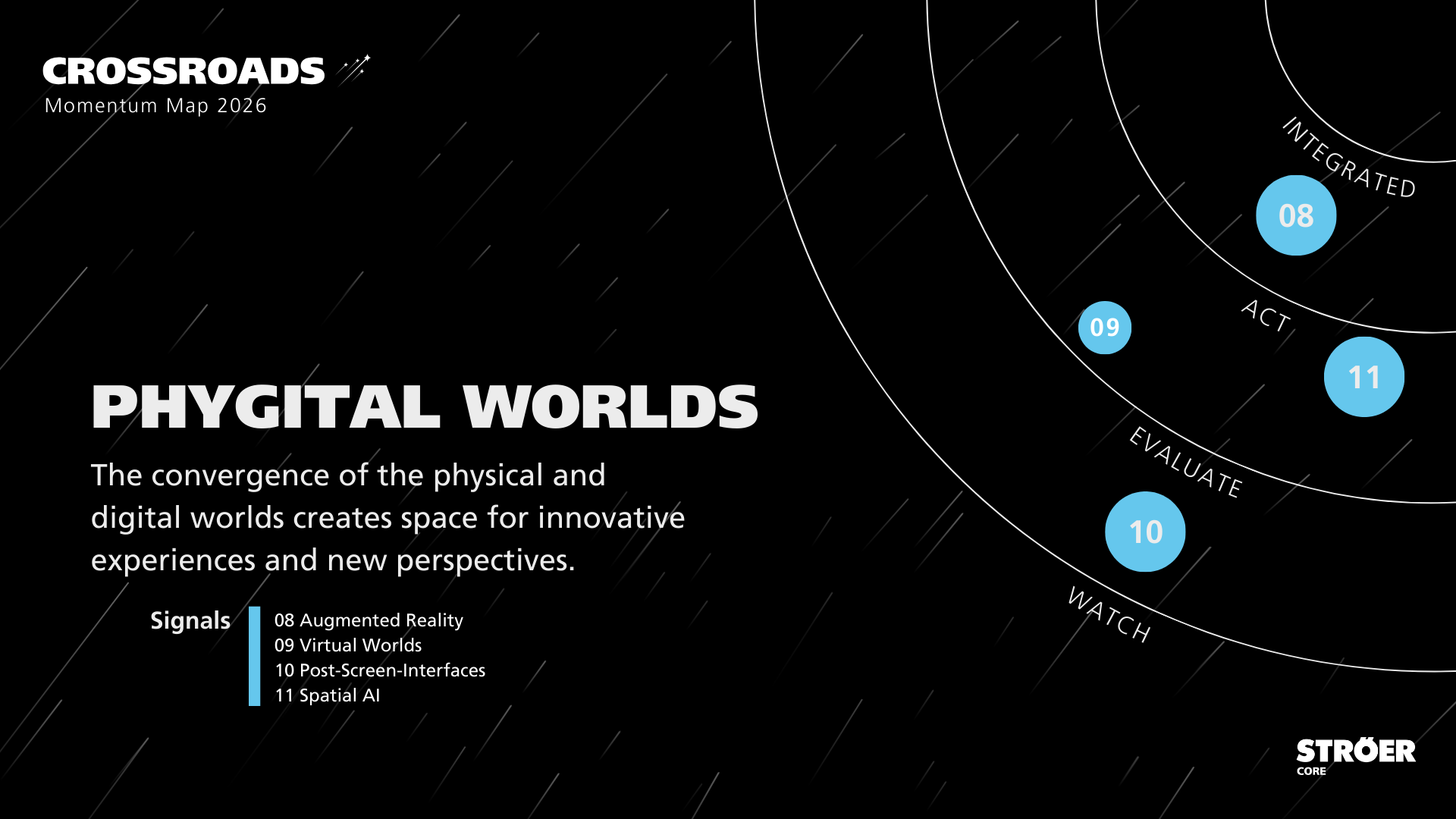
In the Momentum Map, the macrotrend Phygital Worlds represents this structural change. Media, brands and technologies are converging to form spatial, emotional and participatory spaces of experience in which physical presence merges with digital content, AI-supported interaction and social participation. Media no longer act solely as transmitters of content, but increasingly as designers of environments, interfaces and experiences – and often as hosts of communities, marketplaces and events.
The following four signals show how concretely this change is already manifesting itself and what strategic opportunities it offers media companies.
AR glasses and social AR bring content into urban spaces
Augmented Reality
Augmented reality enhances the real environment with digital content that is context-sensitive and linked to it. AR experiences are becoming increasingly suitable for everyday use: smart AR glasses display navigation or information directly in the field of vision, and AI functions generate or personalise content spontaneously according to context or user requests. One example of this is Meta's Ray-Ban Display Smart Glasses, which display news, live translations and directions directly on the lens – a step towards hands-free, situationally relevant AR experiences.
Marketing and media companies are using AR to increase interaction and attention: social AR campaigns achieve higher engagement rates and brand loyalty because they actively involve users rather than passively informing them. Games and experiences such as Niantic's Peridot experiments also show how AR interactions are enriched with real-time environments and AI elements.
For brands, this opens up the opportunity to make content situational, physical and directly experiential – for example, through AR overlays in city centres, on-site product explanations or interactive presentations at events. At the same time, the challenge lies in designing these experiences to be content-rich, context-sensitive and brand-coherent, rather than degrading them to mere gimmicks.
How media companies are building social VR formats and brand spaces
Virtual Worlds
Virtual worlds are entirely digital spaces in which users interact, explore and experience content together as avatars. They are becoming increasingly important as social, narrative and interactive spaces for experiences. Events such as the IMMERSIVE X 2025 festival series bring together creative minds and communities to experience and discuss immersive technology, live performances and XR culture in virtual environments.
Brands and media use these spaces for specific engagement formats: virtual showrooms and persistent brand spaces are emerging as permanent meeting places where users can explore products, interact or participate in digital events. At the same time, digital fashion worlds and avatar economies are gaining traction; platforms such as DRESSX combine virtual fashion experiences with social interactions and digital identity formation.
For media companies, this means that content can be consumed not only linearly, but also spatially, socially and participatively – for example, in joint VR sessions, hybrid events or persistent brand communities. The strategic challenge is to connect these virtual spaces with clear narratives, organisational logic and long-term community loyalty, rather than treating them as short-lived experiments and thus losing their impact.
Interfaces for media beyond traditional surfaces
Post-Screen Interfaces
Post-screen interfaces shift interaction with digital systems away from the screen and towards natural signals such as speech, gestures, gaze or context. Interfaces are increasingly fading into the background and becoming part of the environment, while AI-supported systems interpret multiple inputs simultaneously and respond depending on the situation.
Specific applications show how close to everyday life this change already is. Live translation functions via earbuds from Apple and Google make it possible to understand conversations in real time without using a display – information is provided directly through audio. XR applications and wearables also combine speech, eye tracking and gestures to control content hands-free and make it accessible.
For media companies and brands, this creates new, contextual touchpoints beyond traditional interfaces. Content can be delivered depending on the situation, experienced without barriers and seamlessly integrated into everyday life, public spaces or events. The key here is to think of interaction not as a technical function, but as part of a consistent content and narrative logic.
When AI understands spaces and controls experiences in a context-sensitive manner
Spatial AI
Spatial AI describes AI systems that capture, interpret and respond to their physical environment in real time. The combination of computer vision, sensor technology, audio signals and AI models creates a spatial understanding that goes beyond mere object recognition and incorporates situations, movements and context. As a result, digital systems no longer operate in isolation, but are embedded in real environments.
Specific applications show how spatial AI is already being used: platforms such as Niantic use spatial AI to accurately capture physical locations and deliver context-sensitive AR experiences, for example in location-based games or web AR installations. With Omniverse and spatial computing frameworks, NVIDIA is also focusing on AI models that digitally map and simulate real spaces – for training, media productions or virtual set extensions, for example.
edia companies, spatial AI opens up new forms of spatial staging. Content can adapt to the movements, attention or locations of users – for example, in exhibitions, events or urban installations. The strategic challenge is not only to use spatial intelligence technically, but also to integrate it specifically into dramaturgy, storytelling and user guidance.


Fazit
Content becomes an experiential space
Phygital worlds are changing the way media companies see their role. They're becoming curators of spaces where content, interaction, and transactions all come together. The rules of storytelling, advertising, and brand management are expanding not just in terms of content, but also in terms of space and sensory experience.
Those who manage to orchestrate a combination of physical and digital touchpoints will not only tell stories, but also create worlds in which target groups live, work, play – and buy.
Make sure you don't miss out by following us: check our blog regularly or follow us on LinkedIn!
Some of the media content in this blog post was created using artificial intelligence (AI).
Bezmalinović, T. (2026, January 6). Meta Ray-Ban Display bleibt vorerst US-exklusiv. heise online. www.heise.de/news/Meta-Ray-Ban-Display-bleibt-vorerst-US-exklusiv-11131450.html
Gucci Garden On Roblox. (n.d.). Gucci.com. Retrieved February 2, 2026, from www.gucci.com/us/en/st/stories/article/gucci-gaming-roblox
Inventing the future, with genetically unique AI pets —. (n.d.). Peridot. Retrieved February 2, 2026, from playperidot.com/de
Mitchell, B. (2025, July 25). Man City football club launches VR experience on stadium tour. Blooloop. blooloop.com/technology/news/manchester-city-virtual-reality-experience-stadium-tour/
NIKELAND auf Roblox. (n.d.). Nike.com. Retrieved February 2, 2026, from www.nike.com/de/kinder/nikeland-roblox
We wait. (n.d.). Aardman.com. Retrieved February 2, 2026, from www.aardman.com/interactive/bbc-connected-studios-we-wait/
WPP. (n.d.). MediaCom: Coca-Cola´s Douyin ZaiZai Party. Wpp.com. Retrieved February 2, 2026, from www.wpp.com/en-us/featured/work/2022/10/mediacom-cocacolas-zaizai-party?