


12. February 2026
Hyper-Individualization: When brands learn to think empathetically
The expectation of media and advertising is clear: speak to me, not just anyone. Users want to be understood without feeling exposed. They expect content that is tailored to their needs and moods, and they want it all without losing control or having their data misused. Personalization is not only a technical task, but also an emotional and ethical one. Those who personalize communication not only based on context, but also empathetically and voluntarily, gain relevance and trust.
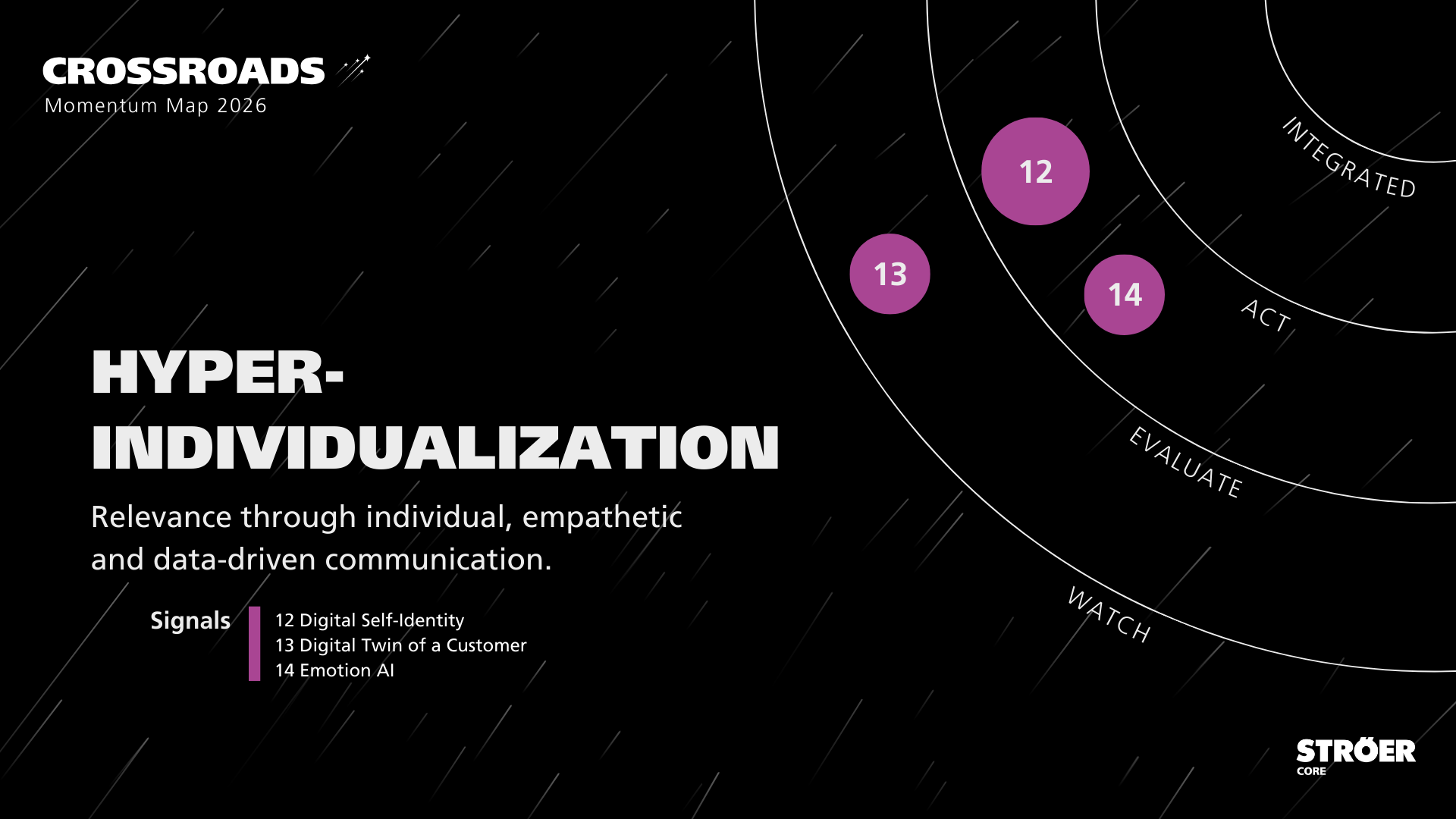
In 2026, hyper-individualization stands for the combination of artificial intelligence and user sovereignty – admittedly, a rather challenging balancing act that can help brands clearly differentiate themselves from others. Companies that master this balancing act will secure trust, differentiation, and brand loyalty in the long term in a data-driven media future. In a fragmented media world, personalized communication is thus becoming a basic prerequisite for relevance. The three signals of digital self-identity, digital twin of a customer, and emotion AI are particularly important for the macrotrend of “Hyper-Individualization.”
Data sovereignty as the basis for personalized media offerings
Digital Self-Identity
Digital Self-Identity (DSI) enables users to manage their digital identity independently of central platforms. With the help of decentralized technologies such as blockchain, personal data can be stored securely and shared selectively. In the media sector, this means individually controllable profiles where users themselves determine what information they share with a provider. This model strengthens data protection, reduces dependence on third-party providers, and creates the basis for transparent, trustworthy interactions.
Currently, initiatives such as IDunion and the EUDI Regulation (European Digital Identity) are promoting the development of interoperable, Europe-wide identity systems. New standards such as verifiable credentials and selective disclosure enable practical web and app applications in which only the data absolutely necessary for a service is transmitted. This allows companies to establish trusting, data protection-compliant customer relationships that offer a significant advantage, especially when personalized content is a priority.
The Belgian app itsme provides a practical example: it is used by more than seven million citizens, i.e. over 80% of adults in the country, and is an official, state-approved means of identification. itsme combines a smartphone, SIM card, and personal code so that users can log in securely to banks, government agencies, or media platforms. Users decide for themselves which data to share, for example, only their name and age or additional information for personalized offers. Digital signatures via itsme are legally valid and comply with European eIDAS standards. Digital self-identity is key to personalized media offerings that respect data protection and user autonomy. They reduce dependence on data monopolies, open up new business models, and form the technological basis for hyper-individualization on a voluntary, transparent basis.
The virtual twin for personalized customer experiences
Digital Twin of a Customer
The “Digital Twin of a Customer” (DToC) is a dynamic, AI-based representation of a real user. It feeds in real time from various data sources, such as social media, CRM systems, streaming, and website interactions, and analyzes behavior, preferences, and usage habits across channels. The goal is to generate tailored content, offers, and touchpoints that are not only efficient but also empathetic. In Germany, the use of such systems is possible in principle, but is more restricted by data protection, governance, and compliance requirements than in the US or Asia. Accordingly, DToC is implemented more implicitly in this country, for example as simulation- and forecast-oriented further development of existing CDP architectures, and less as an explicitly named, comprehensive digital twin of individual persons.
Companies are currently moving gradually in this direction, for example through probabilistic models, scenario simulations, and AI-supported decision-making logic. The systems learn with each contact and provide concrete recommendations for tailored marketing measures. This results in a continuously updated customer profile that goes far beyond classic segmentation.
Digital customer twins provide deep insights into user behavior and open up new avenues for proactive, data-driven interaction. Companies benefit from optimized customer journeys, higher conversion rates, and sustainable customer loyalty—provided that data is used transparently, securely, and in the interests of users. In general, however, implementation in Germany has so far focused primarily on industrial digital twins.
As of today [January 14, 2026], there are no concrete live examples of real “digital twins of customers” in the sense of customer twins being used productively in real companies. This is because many projects are still in a proof-of-concept or research phase and are not widely referenced publicly. Nevertheless, there are sources that define and explain such concepts and describe them in specific scenarios.
Empathetic machines with legal limits
Emotion AI
Emotion AI (also known as affective computing) refers to AI systems that can recognize and respond to human emotions based on facial expressions, voice, gestures, or physiological signals. In the media, tech, and entertainment sectors, this enables mood-dependent content, empathetic voice assistants, or adaptive advertising that dynamically adjusts to the emotional state of users.
In Germany, interest in Emotion AI is growing, especially in customer service, e-learning, and interactive media formats. At the same time, the EU AI Regulation (EU AI Act) has set strict limits since 2025: its use in education, work, and public spaces is largely prohibited in order to protect data privacy and privacy.
Technologically, however, precision is increasing. Multimodal systems are analyzing facial expressions, voice, and physiological data with increasing reliability. Research initiatives such as the MER Challenge 2025 are advancing the technical capabilities to recognize and interpret the finest emotional nuances, which is particularly advantageous for interactive formats with high user engagement. The market is expected to grow at an annual rate of 14.30% through 2034.
Disney+ experimented with emotion recognition via camera or microphone interfaces in test groups as early as 2024 to identify how viewers react to certain movie scenes. If a scene triggers laughter, surprise, or suspense, the system can automatically suggest appropriate trailers, bonus material, or similar content. This creates a personalized, emotion-driven streaming flow that increases engagement and viewing time.
Emotion AI opens up new dimensions for personalized, empathetic user experiences, from individualized service to mood-adaptive media content. However, technological progress must go hand in hand with strict data protection and ethical standards. Companies that operate transparently in this area not only ensure legal certainty, but also gain a noticeable competitive advantage.


Conclusion
Hyper-individualization is more than a technology trend; it is a paradigm shift in the way brands communicate with people. The combination of AI, emotional intelligence, and digital self-determination enables deeply personalized experiences that respect both user needs and data privacy. Those who use the new possibilities responsibly will position themselves as trustworthy providers in a media future characterized by relevance and empathy.
Make sure you don't miss out by following us: check our blog regularly or follow us on LinkedIn!
Some of the media content in this blog post was created using artificial intelligence (AI).
Advertising Week. (2023, July 10). WTF is a digital twin of a customer? Advertisingweek.com. https://advertisingweek.com/wtf-is-a-digital-twin-of-a-customer/
Cross-Kovoor, T. (2024, February 12). Disney enables emotion targeting with “Disney’s Magic Words.” VideoWeek. https://videoweek.com/2024/02/12/disney-enables-emotion-targeting-with-disneys-magic-words/
Delve, A. I. (n.d.). Digital twin of a customer: How it can help you plus what is it. Delve.Ai; Delve AI. Retrieved February 2, 2026, from https://www.delve.ai/blog/digital-twin-of-a-customer
Itsme® home. (n.d.). Itsme-id.com. Retrieved February 4, 2026, from https://www.itsme-id.com/
Marktgröße und Wachstum für Emotionserkennung und -erkennung [2034]. (n.d.). Fortunebusinessinsights.com. Retrieved February 2, 2026, from https://www.fortunebusinessinsights.com/de/industrie-berichte/markt-f-r-emotionserkennung-und-erkennung-101326
The EUDI Wallet. (n.d.). Bundesdruckerei.de. Retrieved February 4, 2026, from https://www.bundesdruckerei.de/en/innovation-hub/eudi-wallet-sicher-digital-identifizieren-europa
What is a Digital Twin of a Customer? (n.d.). Genesys. Retrieved February 2, 2026, from https://www.genesys.com/definitions/what-is-a-digital-twin-of-a-customer
(N.d.). Maresmedia.Se. Retrieved February 2, 2026, from https://www.maresmedia.se/die-verwendung-von-empathischen-algorithmen-im-marketing-fuer-kundenbindung-und-markenfuehrung/